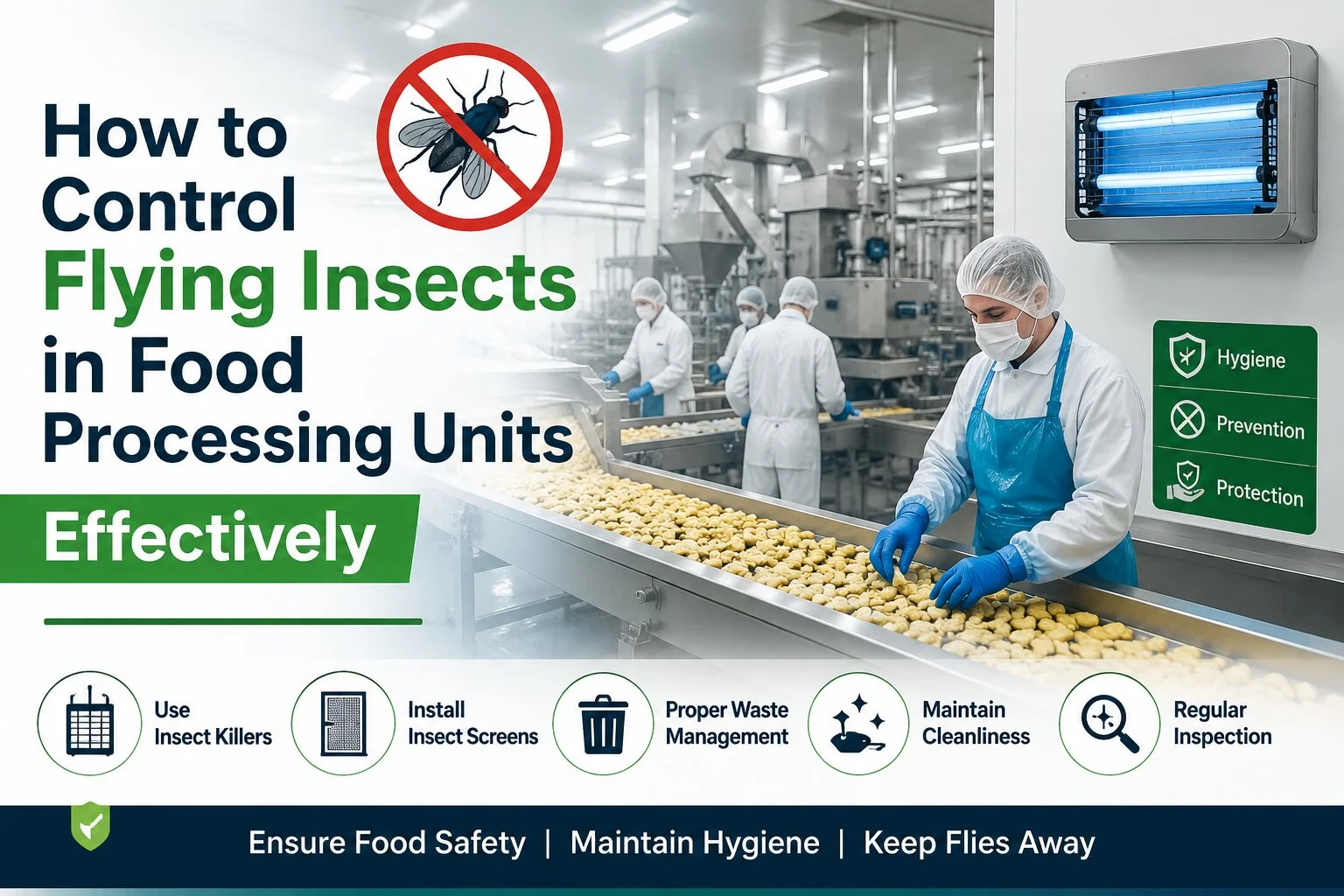
Why Flying Insects Are a Bigger Risk in Food Units Than Anywhere Else.
In a restaurant or office, an insect problem is mostly a comfort issue. In a food processing unit, it's a compliance and safety issue. A few reasons this matters more here:
- Exposed raw material and packaging lines have zero tolerance for contamination
- FSSAI, ISO, and HACCP audits specifically check for pest control documentation
- Insect fragments or residue can compromise an entire batch, not just one product
- Chemical sprays near food-contact surfaces are restricted or banned outright
This is why food units lean almost entirely on UV-based, chemical-free insect control equipment instead of sprays or coils.
Step 1: Fix the Basics Before Adding Equipment.
No machine can outperform poor housekeeping. Before investing in insect control units, these fundamentals need to be in place:
- Seal entry points — gaps under doors, torn window screens, and open loading docks are the top three ways insects get in
- Manage waste daily — covered bins, timely removal, and distance from processing zones
- Control moisture — standing water and food residue on floors are breeding grounds for flies
- Clean drains regularly — clogged drains are a common, overlooked source of fruit flies and drain flies
Once these are handled, the remaining insects entering through doors, vents, or deliveries need to be intercepted — that's where UV insect control units come in.
Step 2: Understand the Two Types of UV Insect Control Technology.
|
Technology |
How It Works |
Best Suited For |
|
UV + Glue Pad |
UV light attracts insects, which get stuck on an adhesive board |
Areas near exposed food, packaging lines, QC benches — no fragmentation risk |
|
UV + Electric Grid |
UV light attracts insects onto a high-voltage grid that eliminates them on contact |
Warehouses, loading docks, waste zones — higher insect load, no food-contact concern |
Most food processing facilities use both — glue-based units in food-sensitive zones, and grid-based units in back-of-house or high-traffic insect areas.
Step 3: Choose the Right Equipment for Each Zone.
Here's a side-by-side comparison of four commonly used models for food processing environments:
|
Specification |
Gluepad Series 1 |
Gluepad Series 2 |
C-1100 |
C-1500 |
|
Technology |
UV Light + Glue Pad |
UV Light + Glue Pad |
UV Light + Glue Pad |
UV Light + Electric Grid |
|
Body Material |
ABS |
MS Powder Coated |
MS Powder Coated |
MS Powder Coated |
|
Size |
20.4" x 4" x 13.5" |
20" x 5" x 13" |
24.5" x 4.25" x 15" |
24.5" x 5.75" x 16" |
|
UV Tubes |
3 x 15W UV Blue |
2 x 15W UV Blue |
2 x 18W UV Blue |
2 x 18W UV Blue |
|
Coverage Area |
400–500 sq. ft. |
300–400 sq. ft. |
400–500 sq. ft. |
400–500 sq. ft. |
|
Power Consumption |
50 Watt |
50 Watt |
60 Watt |
60 Watt |
|
Warranty |
1 Year (Ballast & PCB) |
1 Year (Ballast & PCB) |
1 Year (Ballast & PCB) |
1 Year (Ballast & PCB) |
|
Ideal Placement |
Near packaging & QC areas |
Processing zones, humid areas |
Corridors, dispatch, packing floors |
Warehouse, loading dock, waste zones |
|
Product Link |
Gluepad Series 1 is a lightweight ABS-body glue trap, ideal for placement close to production lines and packaging areas where fragmentation-free trapping matters most.
Gluepad Series 2 offers the same glue-trap safety in a tougher MS powder-coated body, making it better suited to zones with more moisture, cleaning cycles, or daily wear.
C-1100 Flying Insect Killer is a versatile mid-size unit for corridors, dispatch areas, and general processing floor space needing continuous, low-maintenance coverage
.
C-1500 Flying Insect Killer combines UV attraction with a high-voltage grid, built for larger industrial zones like warehouses and waste-handling areas where insect load is higher and fragmentation isn't a food-safety concern.
Step 4: Position Units the Right Way.
Even the right equipment underperforms if placed incorrectly. Keep these placement rules in mind:
- Don't face units toward open doors or windows — this can pull in more insects from outside instead of trapping the ones already indoors
- Keep distance from open food lines — even glue-based traps should sit a safe distance from exposed product
- Use multiple units for large spaces — one oversized unit in the center is less effective than a few units placed at entry points and corridors
- Match the unit to the zone's sensitivity — glue pad models near food, grid models in back-of-house areas
Step 5: Maintain and Monitor Consistently.
- Replace glue boards once they're visibly full — a saturated pad stops trapping effectively
- Wipe down UV tubes periodically since dust buildup reduces attraction strength
- Track insect counts per zone — a sudden spike usually points to a nearby entry gap or waste issue
- Keep a maintenance log for each unit — useful documentation during FSSAI and hygiene audits
Final Thoughts.
Controlling flying insects in a food processing unit isn't about buying one machine and forgetting it — it's about layering facility hygiene, the right UV technology for each zone, and consistent maintenance. Glue-based units like the Gluepad Series 1 and Gluepad Series 2 work best near food-contact and packaging areas, while grid-based units like the C-1100 and C-1500 are better suited to warehouse and back-of-house zones with heavier insect pressure.
Ascone manufactures all of these units in-house across India, with support for single-unit orders as well as bulk supply for multi-location food businesses. Get in touch to find the right combination of units for your facility.