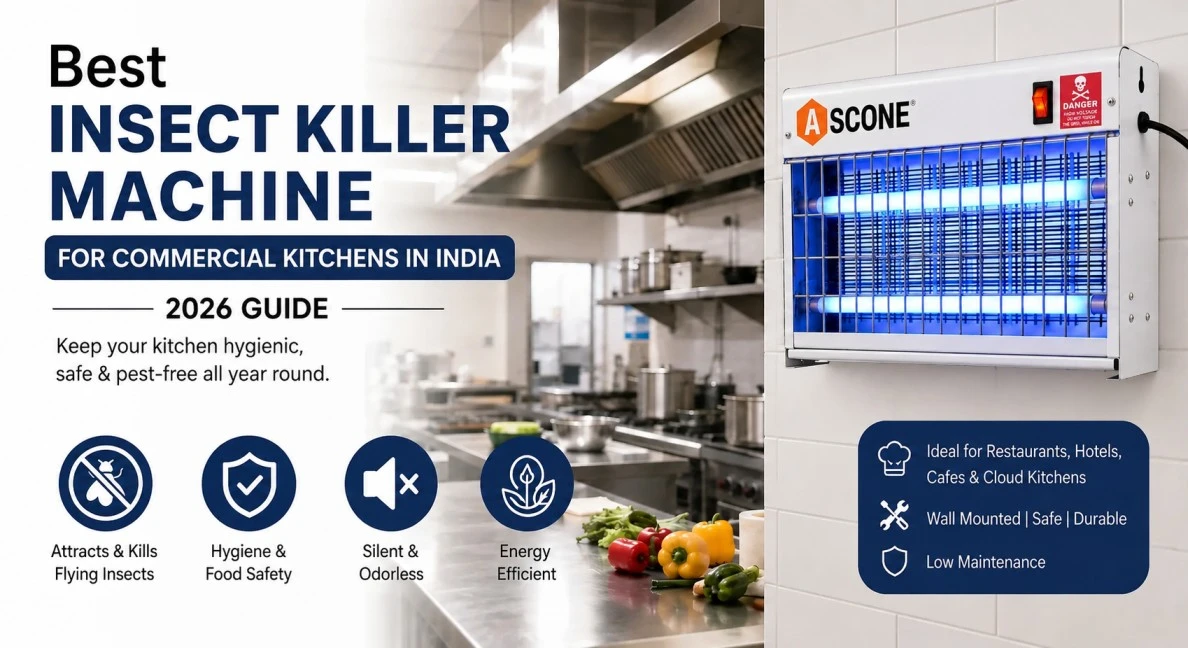
Why bother with a dedicated machine at all?
FSSAI audits are one reason. Inspectors look for visible pest control, and a wall-mounted UV unit is often the easiest way to show you're serious about it. But honestly, even without an audit coming up, the practical case is strong. Flies near open food mean contamination risk, and contamination risk means wasted stock, unhappy customers, or worse — a complaint that goes public. A decent insect killer machine for commercial kitchen zones pays for itself fairly quickly once you account for what a single bad review or spoiled batch costs you.
The different types you'll come across
Electric fly killers (EFK) — these pull insects in with UV light and then either zap them on a charged grid or stick them to a glue board. For kitchens, glue boards tend to be the better call near food prep, since electrocution units can scatter insect fragments, which is exactly what you don't want next to an open counter.
Electrocutor grids — these are the louder, more aggressive option. Great for back-of-house, waste storage, or loading areas where nobody's plating food nearby.
Glue board traps — quiet, low-fuss, and a good fit for dining areas or billing counters where noise and mess both matter.
Combo units — a lot of newer kitchens are going with machines that pair UV-LED attraction with a glue board. It's a reasonable middle ground if your kitchen handles both cooking and packaging in the same space.
What actually matters when you're buying one
A few things worth checking before you hand over money:
Coverage area first. A 20W unit generally handles somewhere around 60–80 square meters, so a larger kitchen is going to need more than one unit, not a bigger single one.
Then think about where it's going. If it's near food, glue board. If it's tucked away near the bins, an electrocutor grid is fine and honestly more effective there.
Build quality matters more than people expect. Stainless steel bodies hold up against grease and humidity far better than plastic housings, and in an Indian kitchen, that difference shows up within a year, not five.
Don't ignore the running costs either — UV tubes and glue boards need replacing regularly, so check what that'll cost you before you commit to a brand.
Look for ISI, CE, or BIS certification too, especially since these units sit near gas lines and electrical points.
And think about noise. A dining-facing unit should be silent. Nobody wants a zapping sound near guests.
Where to actually install it
This trips people up more than the machine choice itself. Keep the unit away from kitchen exhaust airflow — the pull from an exhaust fan can literally drag insects away from the trap before it catches them. Mount it around 6–7 feet high, out of direct sunlight (which weakens the UV pull), and near doors, windows, or bins rather than directly over a prep counter.
Sizing it to your kitchen
For a small cloud kitchen under 500 sq. ft., one compact glue-board unit near the entrance or bin area usually covers it. Mid-size restaurants, somewhere between 500 and 1500 sq. ft., generally need two or three combo units spread across prep, wash, and the area near dining. Larger hotel or catering kitchens above 1500 sq. ft. tend to do best with a mix — electrocutor grids in the back, glue boards up front near food handling — installed as a proper zoned plan rather than just scattered around.
Keeping it working
A machine that's installed but never cleaned is almost worse than not having one, because it gives you a false sense of coverage. Wipe down the tray and glue boards weekly during peak season — monsoon and summer especially. Swap UV tubes every 6–9 months even if they still look fine; the attraction power fades well before the bulb visibly dims. And keep the whole unit clear of steam or water spray, since that's usually what kills these machines early.
Bottom line
At this point, an insect killer machine for commercial kitchen use isn't really optional in India — it's closer to a baseline requirement, the same way a fire extinguisher is. What actually varies is which type fits your space: glue boards where food is exposed, electrocutors where it isn't, and enough units to actually cover your square footage instead of relying on one machine to do everything. Get the placement and upkeep right, and it'll quietly do its job without you thinking about it much.